Coop for Kyodo: How a Small Team Scales Online Safety
Published
Small teams today must keep their users safe in a rapidly changing threat landscape. To do so, many face the unsavory choice between expensive enterprise trust and safety vendors built for someone else's budget, building in-house tooling with engineers they don't have, or shipping without safety infrastructure altogether.
Kyodo chose a different path. Kyodo is a community-first messaging platform that has grown rapidly from a passion project to over 700 million messages sent by users in its two years so far. This explosive growth meant that the Kyodo team needed to look for a scalable solution to protect their users. By using Coop, ROOST's open source content review and enforcement system, Kyodo was able to transition from a time-intensive internal build to a cost-efficient, production-ready infrastructure in just a few days.
Despite costing $260 per month (a 60% reduction vs. other alternatives), Coop has helped Kyodo greatly improve its safety operation by enabling automation, deploying key integrations out of the box, and providing proactive and clear analytics tracking – especially around child safety. After two weeks of using Coop, Kyodo had already captured 19 threats to child safety that would have otherwise gone undetected. Given Kyodo’s size, being able to rely on ROOST’s strong community of open source developers for implementation support has been critical to troubleshooting.
“Coop allowed us to take user safety to a whole other level, especially on the child safety side. I love this tool, [it is] insanely worth it.”
- Kyodo CEO & Co-Founder
Kyodo’s story represents the path forward for safety-forward smaller organizations: a cost-effective open source solution that is highly performant, feature-rich, and well supported.
From Pain Points to “It’s Peak”
Before Coop, Kyodo relied on a self-built content review system with no queuing functionality. Reports could only be grouped by user, making cases hard to moderate and leaving the team with a steadily growing backlog. Kyodo's situation isn't unusual: as organizations scale, many end up patching together band-aid fixes to keep up with new threats.
The Kyodo team discovered Coop before the 1.0 release and liked what they saw enough to rebuild their existing system around Coop's UI and queuing model. That interim update alone let them sort cases into dedicated queues for more coherent review. Within two weeks of experimenting with Coop, they made the full switch, and now benefit from an open-source platform that has received continuous investment since its v0 launch in February.
Since moving to Coop, Kyodo's safety team can now do things its old system never allowed:
Proactive Analytics: Coop’s analytics dashboards enable Kyodo to more easily track key metrics, from topline cases reviewed (roughly 5,600 in a single week) to hyper-specific metrics such as the number of cases automated via known chatbot matches (99 that same week). This visibility helps the team monitor and deep-dive into new threats more proactively, including issuing 19 NCMEC reports in under two weeks.
Child Safety: Before Coop, every report to NCMEC was manual. Coop’s built-in, out-of-the-box integrations, including NCMEC reporting and third-party APIs like OpenAI’s Moderation API, enable targeted identification and resolution once credentials are provided.
“The NCMEC integration is the one thing that was looming over our shoulders, because we had to do it manually each and every time, which was absolutely horrible.”
In one week, Kyodo investigated 24 cases via Coop’s child safety flow – a much faster process than before. Beyond the technical integration, ROOST also organized a working session between Kyodo and NCMEC to help ensure Kyodo’s reports are high quality and actionable, strengthening the handoff between Kyodo's safety team and NCMEC's review process.
“The most important thing, since we have children on the platform: we had 19 cases of [child exploitation and abuse] caught and reported to NCMEC.”
- Kyodo CEO & Co-Founder
Customized Permissions: Kyodo’s old system didn’t have any real permissions. Instead of treating all case reviewers as either an admin or not, Coop lets Kyodo assign different roles, like an external moderator or an analyst, creating a more streamlined, controllable, and targeted review process.
Data Control: With Coop, Kyodo has full control of its data, ensuring that every piece of data Kyodo uses for safety, including any information about their users, stays within Kyodo’s systems.
Together, these capabilities have moved Kyodo from reactive firefighting to proactive and timely protection. A stronger safety operation also benefits the rest of the organization, as Kyodo’s engineering team can now spend even more time focusing on the platform’s core functionality.
Choosing Open Source
In addition to a highly performant solution, Kyodo also needed a tool their team could scale, and Coop fit the bill for two reasons: First, everything is visible and within their control. Kyodo currently runs Coop for $260 per month for a team of six reviewers, with all costs driven by infrastructure services rather than a fee based on the number of reports or platform usage.
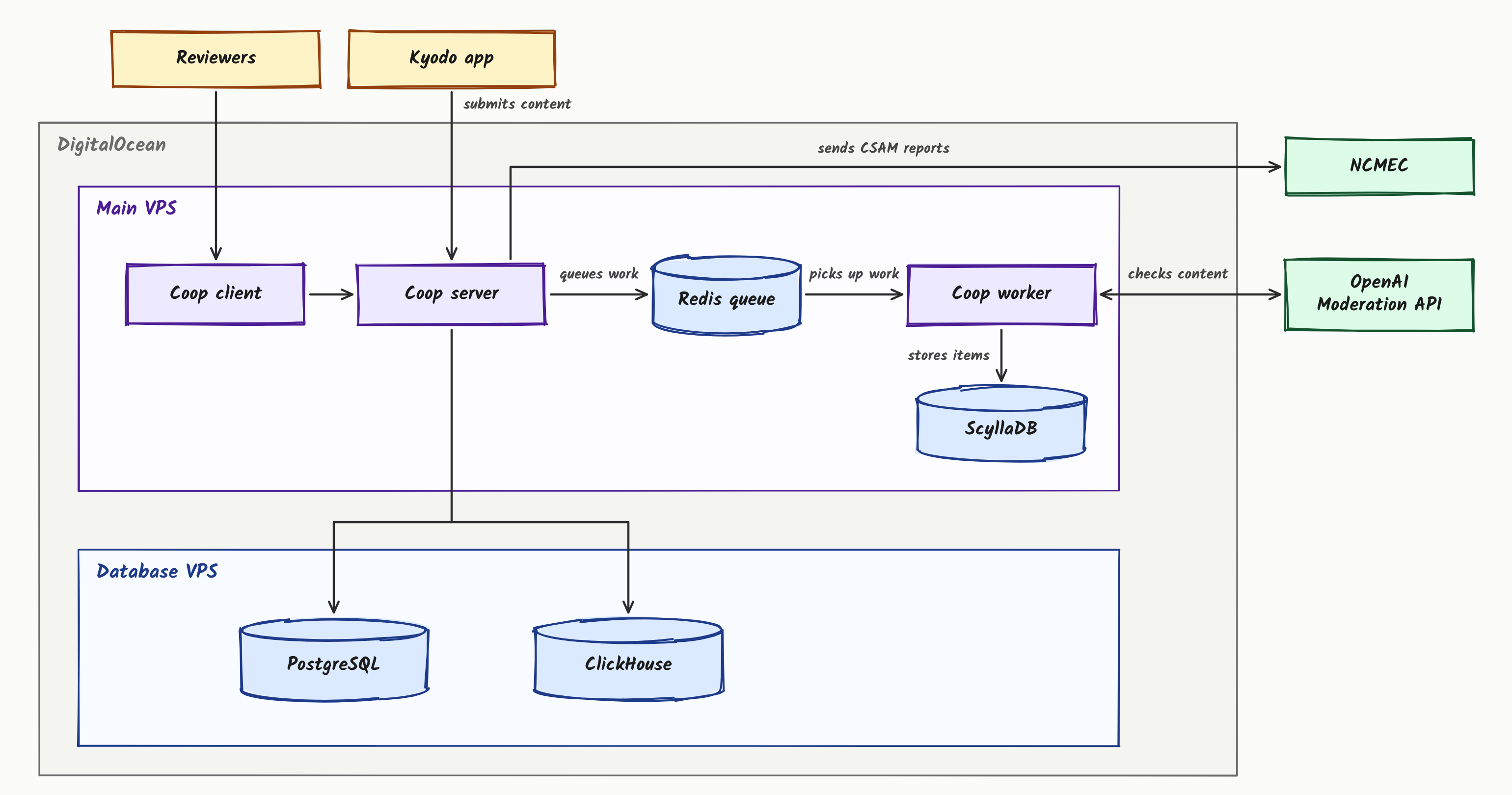
That infrastructure is deliberately lean: Kyodo runs Coop on DigitalOcean, pulling it directly from GitHub onto a main virtual private server (VPS) that hosts Coop’s server, review interface, and background worker. Heavier databases like ClickHouse and PostgreSQL run on their own separate servers so each can scale independently. Because Kyodo’s team decides how Coop is deployed, they control its ultimate footprint, and they can fix bugs and add new features that benefit everyone using Coop.
Second, Kyodo was able to get the help they needed at every twist and turn because Coop is open source and actively maintained. No product is perfect, especially at the start of its journey. But open source contributors throughout the ROOST ecosystem ensure that bug fixes and implementation support are always within reach, whether through the weekly Coop working group or the ROOST Discord server. Because the ROOST community is distributed globally, that support was readily available for the Kyodo team across time zones. This community makes the bumpy road to integration much less daunting, even for smaller engineering teams. For example, when the Kyodo team struggled with the initial integration process due to (at the time) incomplete documentation, ROOST community members went to extreme lengths to help, from identifying how to reduce storage bloat to resolving errors by helping the Kyodo team debug Coop and explaining logs.
“Each and every time I asked for help, I got everything I needed. This is really proactively maintained and open source. I called something out and it was fixed within 2 days. It’s insane, it’s awesome. I genuinely don’t think I could have asked for a better open source team.”
– Kyodo CEO & Co-Founder
What Comes Next
Kyodo's story represents the promise of open source safety, and it's exactly what ROOST is built to accomplish. We are committed to building open, free, and well-maintained tools accessible to everyone. No matter what stage of the safety journey you are on, we are here to help.
Coop is open source and available today. Read more about the Coop 1.0 release here, and join our Discord community for questions and discussion.